This blog is the personal view of Dave King, one of the main organisers of the 50th anniversary celebration. It does not necessarily represent the views of the New Lucas Plan group.
Why am I working so hard to celebrate this anniversary? I’m certainly a great fan of the Lucas Aerospace workers, but I can tell you that it’s certainly not because I am keen to celebrate another of the British left’s many glorious defeats. I’m too old, and the situation is too dire to waste time in that way. The Lucas Plan is a beacon of hope from the time before neoliberalism. What they did was glorious and visionary, a jewel in the crown of British socialism, and we will be celebrating it. But to just to do that, as if what they did was something that is now impossible, would be to betray that hope. It would just be wrong, a way of reinforcing the bleakness and seeming powerlessness of the current moment. For me, the celebration will be primarily as a critical part of what must happen now, but in a new way. I hope the conference will serve as the basis for the creation of a national network for socially useful production.
Here are my thoughts on the current situation and why we need that, inspired by some Lucas Plan-era-and-slightly-later music.
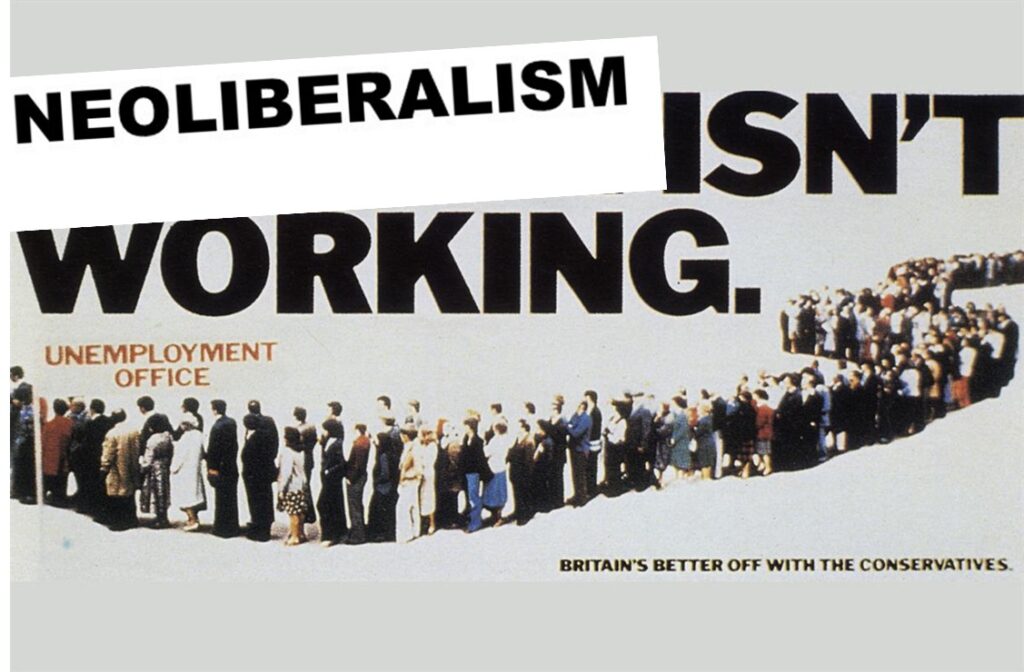
Neoliberalism isn’t working
It was not an accident that the Lucas Plan was created at a time of capitalist crisis, the ‘solution’ to which was neoliberalism and digital technologies. And here we are, 50 years later in a similar but in many ways much worse situation, created by the working out of the logic of neoliberalism. The Sex Pistols ‘No future for you and me’ seems even more to the point than it did in the 1970s.
The fundamental cause of the many crises the world is experiencing is the industrial capitalist mode of production, which is a techno-social system, embracing both material and social relations. The technical and the social aspects are mutually-reinforcing and that is what has made it so powerful. That is what the expression ‘mode of production’ means. The crises of this system are both social and technological, and the solutions must also have both a social and technological component which create a whole new way of organising the world.
Between 1945 and 1975 the Fordist (technological, mass production)/Keynesian (social, class compromise to stave off the threat of communism) mode of production created an empowered working class, organised through trade unions, some sections of which, such as that Lucas Aerospace, were highly technically skilled. Other sections, including in the British case miners, became highly militant and powerful. When geopolitical conditions destabilised the system and the economic tools of Keynesianism failed to work, a major crisis ensued.
A critical aspect of the struggle at Lucas Aerospace was the effort by management to impose new technologies and the Taylorist regime of work discipline and automation. For more background on this techno-political struggle at Lucas and its relevance today in AI’s ‘automation of everything’, see here and here. The Lucas plan addressed both material and social aspects of the crisis in a straightforward practical way. It was an adequate techno-social response to the problem which showed a real viable alternative. Ultimately, the reason the Lucas workers were able to do that was because they were rooted in a working class that both new what was right and knew how to make things that people needed.
The neoliberal ‘revolution from above’ that we got instead was also an example of genuine change in both material and social aspects of production. Apart from its obvious social component of class war against the organised working class, it was critically dependent upon digital technologies. These technologies enabled the growth of vast multinational corporations, which could not be managed without a highly sophisticated communications infrastructure, which eventually became the internet. They also enabled globalisation, i.e. relocation of production to low-wage countries with obvious benefits for profit margins, as well as financialisation and the diversion of manufacturing jobs in the industrialised countries into poorly-paid service sector jobs. Digital technologies disciplined the working class through increasing automation of production and in the service sector in the 2000s, allowed the creation of precarious gig work in the service economy.
After the 2008 financial crash, it became clear that digital neoliberalism’s success was creating the series of crises that we are facing today: erosion of wages and massively increased inequality, leading to political polarisation and instability including the rise of the far right, environmental crises and resultant refugee flows, wars and increasing militarisation, etc. Worst of all from the point of view of the managers of global capitalism, it was failing to produce significant economic growth, and like the 1970s, governments (whose power had been systematically eroded by neoliberalism) have apparently no economic answer to the problem and are at the mercy of corporations and the ‘bond market vigilantes’. There are increasing supply chain problems and industrial capitalism is failing to supply the basics needed for human existence for billions of people, including in the UK. There are already millions of people dependent upon food banks for survival. The system is creaking, because it depends on vast over-complex global supply chains and has so many different points of dependency upon critical materials. The strait of Hormuz is merely one of the most obvious.
Neoliberalism can no longer pretend that it is the only ‘realistic’, ‘practical’ way of doing things, and that ideas like socially useful production are ‘utopian’.
The current situation thus appears very similar to that of the 1970s and even to the 1930s, but perhaps even more extreme due to looming environmental crisis. At this point, it is not clear whether the rise of the far right and the dash for AI are part of attempted short-term solutions for the crisis of neoliberalism or the dawning of a whole new techno-social dispensation, which we can call techno-fascism. My money is on the latter: that is very clearly what Donald Trump and the Silicon Valley oligarchs want and as Naomi Klein and Astra Taylor describe in their book End Times Fascism, it looks more and more clear that the fascist sections of the world elites are deliberately steering for the rocks. There is a very clear synergy/compatibility between the fundamental values of AI and of fascism, but that is for another blog. It certainly seems that we would be foolish to be complacent about this prospect, despite all our scepticism about AI hype.
All three of the looming threats of AI, fascism and climate collapse seem to raise fundamental threats to human survival. This unholy trinity, and the failure of conventional politics to address them seriously should be enough to convince us that it is time for action.
The point of all this is that the neoliberal industrial capitalist emperor simply has no clothes. It has lost its ability to, as we say in Yiddish, ‘mach Shabbes’ (the English equivalent is cut the mustard). Not only can it barely produce any growth, it is struggling to provide people with necessities. It can no longer pretend that ‘There Is No Alternative’, that it is the only ‘realistic’, ‘practical’ way of doing things. It is the neoliberals who are naïve. Arguments that ideas like socially useful production are ‘utopian’ and ‘impractical’ are entirely bankrupt. On the contrary, they are now the only realistic way forward. Sometime, maybe quite soon, the world is going to have to face up again to the basic question of how we supply real social needs. We need a new mode of production. We need vision, the kind of vision the Lucas Aerospace workers showed. The Western lifestyle is already over, this ship is headed for the rocks. We don’t know when, or how, but no one in power is turning this supertanker. I say ‘JUMP! We might as well jump’. Events since 2008 have shown that the longer we try to keep this system going, the worst things will get, and the more cataclysmic the final crash(es) will be. The house is on fire and the fascists are at the door. How long are you going to wait?
So, we are faced with very fundamental political questions, and like the Lucas Aerospace workers, we need to go back to the real material and social roots of the problem: are we producing to satisfy people’s real needs or for profit? We need a new Lucas Plan that provides mutually compatible technological and social answers to that question. The Lucas Aerospace workers were very clear that socially useful products cannot be made with technologies like AI that extract knowledge from workers, deskill them and ultimately replace them. As part of their concept of socially useful production they insisted that only socially beneficial production methods will work. We need an appropriate- and human-centred-technological revolution.
But we should be clear that this is not a matter of creating something entirely new or something extremely old, some aspects of it are already in place, at scale or in embryonic form. For example, there already exists alternative food production systems, based upon a profound critique of both industrialism and capitalism, that feed a good proportion of the world’s population. In many places there are good public transport systems, etc. There are a myriad of socially useful production projects that need to be scaled up and connected to communities.
Do the Right Thing!
Necessity is only half the reason that we need a New Lucas Plan. The other bit is: aren’t you sick and tired of living in a world where we are told that the only way of feeding, clothing, healing, etc people is to use methods that exploit people and destroy the environment? And that if something sells then it is by definition good? Neoliberal capitalism has piled cynicism on top of cynicism and has ended up violating the basic social contract of looking after people. Actually, in order to survive, humanity needs not only a practical solution but a moral revival, and this is another place where the Lucas Plan has shone out as a beacon of hope over the decades. The Lucas Aerospace workers did not buy that capitalist story that only bad means are successful, and that it’s fine to make any kind of trash if it sells. And what made the Lucas Plan stand out and brought them global fame and support was the constructiveness and moral integrity of their response to the threat to their jobs. Although the Plan was never properly implemented, because of that public support they succeeded in protecting jobs at Lucas Aerospace. Contrary to all the stories we’ve been told about the negativity and self-interestedness of British trade unionism, they insisted that they, and we, could do better.
Despite the way that industrial capitalism is palpably coming apart at the seams, we are still held by its spectacle, by the myth of no alternative and by technological dependency. For the last 30 years people have been saying that it’s easier to imagine the end of the world than to imagine the end of capitalism, and now we’ve got to the point where half of us think we are living in the end times. Looks like the only way we are going to escape that is by doing more than imagining the end of capitalism. But first, you have to imagine. What’s your vision? Mine is the Lucas Plan.
The Lucas Plan was not just about conversion of military production and a socially just climate transition, it’s about everything to do with producing the necessities of human life, including social reproduction – how we care for and sustain human beings. In the 1980s the Lucas workers and the Greater London Council began working with communities, asking them what they needed and helping them to create their own plans, such as the People’s Plan for the Royal Docks. This comprehensive approach to production for social need is the reason why I think the Lucas Plan is a critical piece of what needs to come next. At the conference in November we will be looking at the many sectors of the economy and human needs, such as housing and social care, and how they can be fitted in a model of socially useful production.
As we know, crises are also moments of opportunity. This could be our moment. Governments and the market are still stuck in the old ways and seem devoid of good ideas of even how to tinker effectively with their failing system. So, as it was at Lucas Aerospace, it’s up to you and me, however inadequate to the challenge we may feel.
The Lucas Aerospace workers did not make the mistake of thinking were powerless. Instead they took a leap in the dark and did something that had never been done before in the British trade union movement. They reached for something beyond what mainstream common sense said was possible, and they did not wait for their bosses to come up with a new plan. Confident in their own working class knowledge and skills, they took their future into their own hands. They made their own plans and started building prototypes. This is what we all need to do now, we have to start building a new mode of production, because time has comprehensively run out for reformist tinkering with the existing arrangements. The Lucas Plan’s time has come and it is time to act.
We need to build a movement for socially useful production and to put that into action. I cannot say here what that looks like, it can only be worked out in practice by millions of us. Socially useful production is a broad concept: in Architect or Bee, Cooley lists 15 different criteria, and no doubt there are many more. There are many different needs and injustices needing to be put right. What matters though is that we have the discussion on that ground, rather than leaving the provision of the basics of life to the market. Socially useful production is not the only thing we will need, but it is a cornerstone.
The world is crying out for leadership with integrity. So, in addition to all the necessary resisting and criticising the powerful, like the Lucas Aerospace workers, let’s do something constructive, ourselves. As Laura Flanders says at the end of her excellent film on the Lucas Plan, ‘We won’t end up in a different new destination, unless we come up with a clear plan’. Let’s be realistic and demand the ‘impossible’. We will be starting that at the conference on November 21. This could be our moment. Don’t you wanna try it?